The technique I have been using since 1979 has been a multiple warp twill
which produces results that a jacquard loom would make, but I am doing it
by hand. Four sets of warps are wound separately and then wound onto one warp
beam all at once. Each warp is threaded on its own set of 4 shafts, which
makes a total of 16 shafts. Each warp consists of several colors which can
be woven in a 3/1 twill while the other warps weave a 1/3 twill. Blends of
colors can be made by variations with 2/2 twills from two or more warps. By
changing the shed as I weave across each pick, I can bring up different warps
and create a design. (See Weavers Issue 11, 4th Quarter 1990 pp 30-35) This
was slow but provided satisfactory results. These were woven in wool with
32epi and 4ppi effectively giving the detail of 1/8th of an inch by 1/4 of
an inch. I would often think to myself, "If I only had a jacquard loom..."
 In
1991, I was invited to participate in The Jacquard Project- Art & Industry
in Germany at Muller Zell Mill, organized by Beatrijs Sterk of the magazine
Textile Forum. I was thrilled! Lia Cook, Cynthia Schira, Pat Kinsella, Hans
Herpich and myself all had an opportunity to work on commercial computerized
jacquard looms. Vibeke Vestby was also there doing research. The experience
was amazing. The shuttle would weave 400 picks a minute!!! To create my design
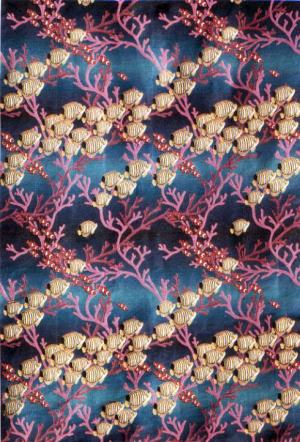
we had to switch the weave structure to multiple weft faced twills. I designed
an underwater scene of clown and angel fish swimming in layers of coral. (See
article in Weavers Issue 15, 4th Quarter 1991, pp 32-35) I had definitely
caught the "bug."
In
1991, I was invited to participate in The Jacquard Project- Art & Industry
in Germany at Muller Zell Mill, organized by Beatrijs Sterk of the magazine
Textile Forum. I was thrilled! Lia Cook, Cynthia Schira, Pat Kinsella, Hans
Herpich and myself all had an opportunity to work on commercial computerized
jacquard looms. Vibeke Vestby was also there doing research. The experience
was amazing. The shuttle would weave 400 picks a minute!!! To create my design
we had to switch the weave structure to multiple weft faced twills. I designed
an underwater scene of clown and angel fish swimming in layers of coral. (See
article in Weavers Issue 15, 4th Quarter 1991, pp 32-35) I had definitely
caught the "bug."
In June of 1998, I was invited by AVL to experiment on their hand jacquard
loom. The head was made in France with 576 hooks(heddles). The shed was electronic,
but the shuttle was still thrown by the weaver. I made a multiple colored
warp and wove up some warp faced Flockettes. It was great fun throwing the
shuttle all the way across the shed with NO shed changes!! The effective detail
was now 1/12th of an inch by 1/12th of an inch with an overall size of 12"
x 10".
In July 1998, I was teaching at Convergence in Atlanta and had the pleasure of seeing what Digital Weaving Norway's TC-1 loom could do. I had known Vibeke Vestby since 1986 where we met when I taught a workshop in Copenhagen. We have kept in touch ever since. Her assistant Katja woveup some of my Flockettes and I could now see the advantage of having one black warp from which several designs could be woven by changing the weft colors.
In the meantime, back at CCAC, Lia Cook ordered a TC-1 loom. Nina Jacobs,
the senior studio manager at CCAC, met Vibeke Vestby at that time, who asked
her to be the representative and technical support for Digital Weaving Norway
in the US and Canada. After working with the loom at CCAC, Nina purchased
a TC-1 loom to develop her own work. In 2000, I had moved from Oakland to
Lake County when I found out that Nina was renting time on the TC-1. I was
now 100 miles north of Berkeley, but I figured that was a lot closer than
Norway!
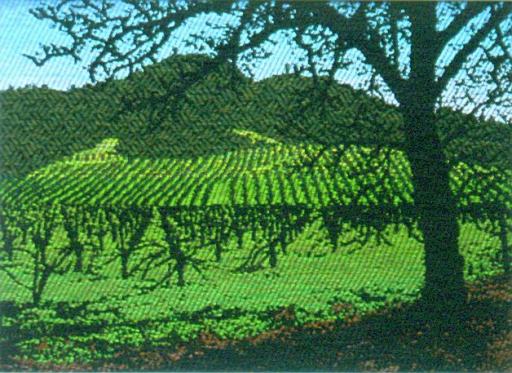
In November 2000 I met with Nina, and we converted my Flockette designs to weft faced weaves. She was able to work with the images I had created in Corel Draw for a triple weft weave. With Nina's expert help, we decided to use 1/7 weft faced twills and a 7/1 warp faced satin. The detail is quite fine with 60epi of 20/2 cotton and 96ppi of 10/2 cotton. This effectively gives a detail of 1/60th of an inch by 1/32nd of an inch, with an overall size of about 7" x 6". The results are crisp, colorful and in great detail. To get color blends I alternate two shuttles in one color, sometimes using up to five shuttles. I am quite pleased, and I have been taking orders.
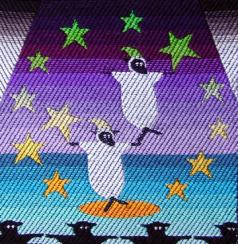
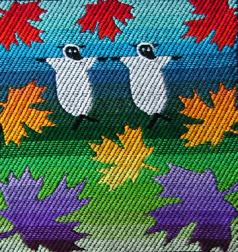
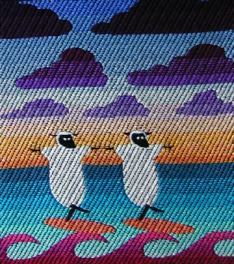
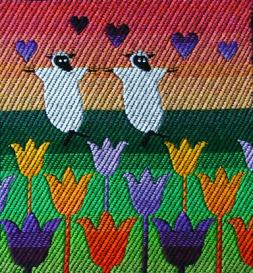
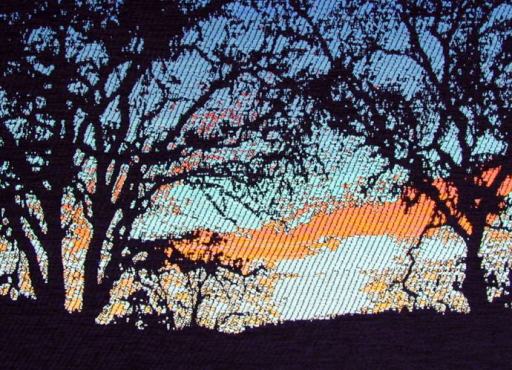
When I was weaving the 30th Flockette, my mind was wondering about new designs.
I had taken pictures of our country landscape and pulled out a photo of a
winter sunset with the silhouettes of oak trees. I asked Nina if we could
try that one. At 9.5" x 12.5" with 60epi, the wonderful intricacy
of the black braches was captured in the weave! It was like magic. I then
went on to weaving it in a larger size of 19" x 25" with 30epi of
10/2. I figured that I would just have to double the 10/2 to make it twice
as hick for the weft. After testing, it turned out that I needed to quadruple
the weft to make it come out in the proper scale. This led me to making blends
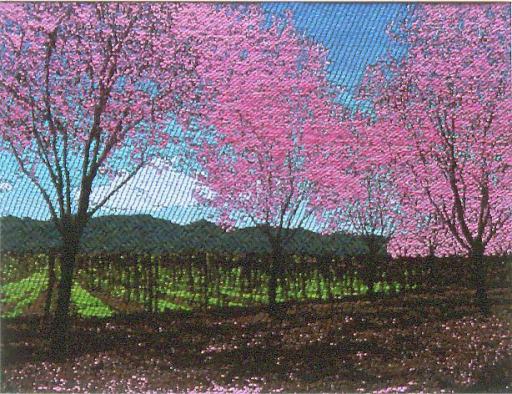
of colors like a rich tapestry. Care must be taken in choosing an image and
in color reduction. This eems to be the biggest challenge so far. When I wove
"Blossom Creek" in the fine weave, I added sewing thread to the
10/2 to get the effect of multiple colors. I also started using weaves other
than twills to enhance the design. This is great fun. I have now completed
three designs in my new country landscape direction. I am inspired by my renewed
connection to the earth and the ability to capture the beauty in a woven image.
I hope you are inspired by the work. I am excited to see where this will lead
me.
Without the jacquard loom these artworks would not be possible. In the meantime
I am almost thinking of buying lottery tickets so that I can buy my own jacquard
loom some day...
Sheila O'Hara